


The Heyrovský Institute Ranks Among the Most Efficient Recipients of Horizon Europe Funding in the Czech Republic
On 30th January 2026, the Technology Centre Prague published an analytical overview of the Czech Republic’s participation in the Horizon Europe framework programme to date. The analysis includes all grant beneficiaries in the Czech Republic—research institutes, universities, and private entities. According to the report, J. Heyrovský Institute of Physical Chemistry of the Czech Academy of Sciences achieved very strong results in securing European funding, ranking 17th overall.
To date, 435 institutions from the Czech Republic have participated in Horizon Europe projects, and 343 of them have received direct financial support. In the nationwide TOP 50 ranking of Czech institutions by the volume of funding obtained from Horizon Europe, the Heyrovský Institute placed 17th (see Table 1). This result is particularly noteworthy given that most institutions ranked above the Institute are significantly larger organisations with many times more research-active staff.
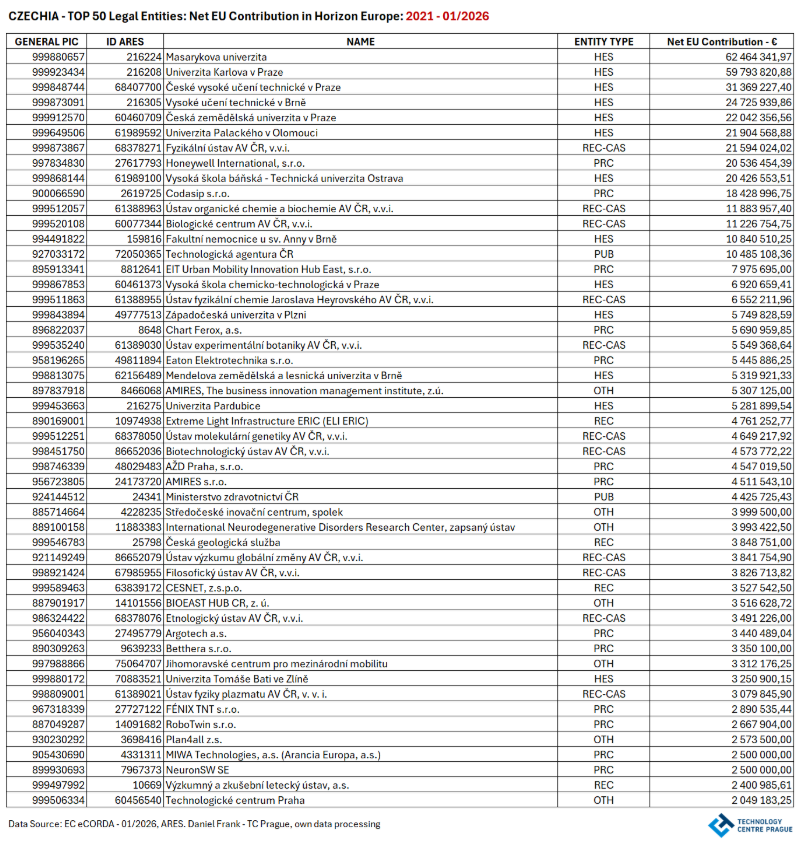
Table 1 – Ranking of legal entities by net contribution from the Horizon Europe Programme (2021–01/2026), Source: Technology Centre Prague
Grant efficiency within the Czech Academy of Sciences
To contextualise this result within the Czech Academy of Sciences (CAS) and to account for differences in the sizes of individual institutes, an efficiency indicator was applied. This indicator expresses the ratio between:
- the volume of EU grant funding received (in EUR), and
- the level of institutional support for the long-term conceptual development of research organisations (RVO).
Within CAS, this ratio serves as a simple indicator of an institute’s capacity to participate successfully in the European Research Area.
Our Institute ranked second
As shown in Table 2, the efficiency indicator for the J. Heyrovský Institute is 1.19. This value represents the ratio between the volume of funding obtained from the Horizon Europe programme in the period 2021–01/2026 (EUR 6,552,211.96) and the level of institutional support for the long-term conceptual development of research organisations (RVO) in 2025 (EUR 5,520,290). When calculating the RVO in Euro, we took 24.7 as the exchange rate which, according to the Czech National Bank, is the average exchange rate of the euro for the year 2025. Among the eleven CAS institutes included in the national TOP 50 ranking, the Heyrovský Institute ranks second in efficiency in securing European funding.
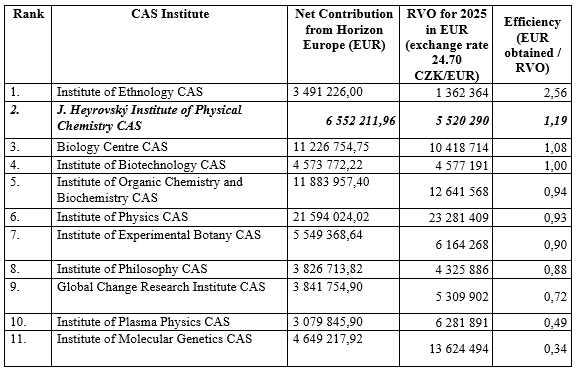
Table 2 – Efficiency of grant acquisition from the Horizon Europe Programme, Source: Technology Centre Prague and Report on the Economic Situation of the Czech Academy of Sciences and the Proposal for Its Budget for 2025 and 2026. Rate 24.7 is the average exchange rate of the euro for the year 2025 according to the Czech National Bank.
“Comparing research institutes and universities is not entirely straightforward, since university academics typically combine research with teaching duties. Even so, the major universities listed in Table 1 operate on a scale more than an order of magnitude larger than ours in terms of research-active staff. Considereing this differences in size, our results show that, within the Czech Republic, only the outstanding Ethnological Institute of the CAS appears to achieve higher efficiency than the Heyrovský Institute. Moreover, the strong portfolio of projects at our Institute clearly demonstrates that our performance has grown significantly in recent years,” said Martin Hof, Director of the Institute.
Results in broader context
The J. Heyrovský Institute currently employs 196 researchers organised into 13 research departments. Since 2011, it has secured a total of EUR 6,552,211 from EU Framework Programmes across the Horizon Europe portfolio, including two ERA chairs, an European Research Council (ERC) grant, a Future and Emerging Technologies (FET)-Open grant, and four Marie Skłodowska-Curie Doctoral Networks. This achievement is primarily driven by the Institute’s excellent scientific output, the international reputation of its researchers, and their long-term ability to succeed in highly competitive European calls.
Professional project support
Equally important is the systematic support for project preparation provided by the Institute’s Project Office led by Jan Hrušák, and the Grants Office led by Růžena Ferusová. The combination of top-level science, experienced research teams, and professional project support enables the Heyrovský Institute to achieve long-term success in Horizon Europe and to strengthen its position as a significant European research institution.
Our Horizon Europe projects
Below you will find an overview of Horizon Europe projects from 2021 to the present in which researchers from the J. Heyrovský Institute of Physical Chemistry of the Czech Academy of Sciences have been involved. The list includes both ongoing and completed projects and illustrates the wide range of research topics in which our Institute has successfully established itself at the European level. The projects are listed by start date, from the most recent to the oldest.
Materials Commons for EU
Coordinator: Ústav fyzikální chemie J. Heyrovského AV ČR
Principal Investigator: Mgr. Marek Cebecauer, Ph.D.
Duration: 2026–2030
WATER - Doctoral Network on Interfacial Water in Membrane Transport
Coordinator: Ústav fyzikální chemie J. Heyrovského AV ČR
Principal Investigator: prof. Martin Hof, Dr. rer. nat., DSc.
Duration: 2025–2027
ERA Chair of Space Chemistry and Technology at the J. Heyrovský Institute
Coordinator: Ústav fyzikální chemie J. Heyrovského AV ČR
Principal Investigator: RNDr. Jan Hrušák, CSc.
Duration: 2025–2029
ALD-protected Next Generation Lithium-Sulfur battery Cell, Akronym: ANGeLiC
Coordinator: MTU Civitta Foundation (CIV)
Principal Investigator: RNDr. Zukalová Markéta Ph.D.
Duration: 2025 - 2028
Career Management Services for European Talents, Akronym: CROSS
Coordinator: VŠCHT Praha
Principal Investigator: Ing. Zuzana Musilová, Ph.D.
Duration: 2025-2027
NEO – Next Generation Molecular Data Storage, Akronym: NEO
Coordinator: Universität Paderborn
Principal Investigator (ÚFCH JH): Mgr. Jaroslav Kočišek, Ph.D.
Duration: 2024–2026
METAMORPHOSIS
Coordinator: Vysoká škola chemicko-technologická v Praze
Principal Investigator (ÚFCH JH): Klaudie Soukupová
Duration: 2024–2026
MicroEnv – Hydride and Hydrogen Transfer Activity in Enzymatic and Nonenzymatic Systems, Akronym: MicroEnv
Coordinator: Ústav fyzikální chemie J. Heyrovského AV ČR
Principal Investigator: Dr. Zuzanna Marta Wojdyla
Duration: 2024–2026
StR-ESFRI3 – Support to Reinforce the European Strategy Forum on Research Infrastructures, Akronym: StR-ESFRI3
Coordinator: Athena Research Center
Principal Investigator (ÚFCH JH): RNDr. Jan Hrušák, CSc.
Duration: 2022–2026
ReMade-at-ARI – Recyclable Materials Development at Analytical Research Infrastructures, Akronym: ReMade-at-ARI
Coordinator: Helmholtz-Zentrum Dresden-Rossendorf
Principal Investigator (ÚFCH JH): doc. Ing. RNDr. Martin Kalbáč, Ph.D., DSc.
Duration: 2022–2026
NanoCAT – Scientific Excellence in Nano-CATalysis at the Heyrovský Institute, Akronym: NanoCAT
Coordinator: Ústav fyzikální chemie J. Heyrovského AV ČR
Principal Investigators: RNDr. Jan Hrušák, CSc.; RNDr. Stefan Vajda, CSc.
Duration: 2022–2025
SUNER-C – SUNERGY Community and Ecosystem for Accelerating the Development of Solar Fuels and Chemicals, Akronym: SUNER-C
Coordinator: University of Utrecht
Principal Investigator (ÚFCH JH): prof. RNDr. Antonín Vlček, CSc.
Duration: 2022–2025
GRASONIC – High Sensitive Wideband Graphene Ultrasonic Transducers, Akronym: GRASONIC
Coordinator: Ústav fyzikální chemie J. Heyrovského AV ČR
Principal Investigator: doc. Ing. RNDr. Martin Kalbáč, Ph.D., DSc.
Duration: 2022–2025
ONEM – Optical Near-Field Electron Microscopy, Akronym: ONEM
Coordinator: University of Vienna
Principal Investigator (ÚFCH JH): Marianna Amaro, Ph.D.
Duration: 2021–2025
TAGGED – TunAble Graphene liGht Emitting Hybrid MOEMS Device, Akronym: TAGGED
Coordinator: Fraunhofer-Gesellschaft
Principal Investigator (ÚFCH JH): doc. Ing. RNDr. Martin Kalbáč, Ph.D., DSc.
Duration: 2021–2024
RADON – Irradiation Driven Nanofabrication: Computational Modelling versus Experiment, Akronym: RADON
Coordinator: MBN Research Center (Německo)
Principal Investigator (ÚFCH JH): Mgr. Juraj Fedor, Ph.D.
Duration: 2020–2025
PROTON – Proton Transport and Proton-Coupled Transport, Akronym: PROTON
Coordinator: Universität Linz / Peter Pohl
Principal Investigator (ÚFCH JH): prof. Martin Hof, Dr. rer. nat., DSc.
Duration: 2019–2024
Heyrovsky Chair – ERA Chair at J. Heyrovský Institute of Physical Chemistry, Akronym: Heyrovsky Chair
Coordinator: Ústav fyzikální chemie J. Heyrovského AV ČR
Principal Investigator: RNDr. Jan Hrušák, CSc.
Duration: 2018–2023
TSuNAMI – Trans-Spin NanoArchitectures: From Birth to Functionalities in Magnetic Field, Akronym: TSuNAMI
Coordinator: Univerzita Karlova
Principal Investigator (ÚFCH JH): doc. RNDr. Ing. Martin Kalbáč, Ph.D., DSc.
Duration: 2017–2022
StR-ESFRI2 – Support to Reinforce the European Strategy Forum on Research Infrastructures, Akronym: StR-ESFRI2
Coordinator: United Kingdom Research and Innovation
Principal Investigator (ÚFCH JH): RNDr. Jan Hrušák, CSc.
Duration: 2017–2022
ELCOREL – Electrochemical Conversion of Renewable Electricity into Fuels and Chemicals
Coordinator: Ústav fyzikální chemie J. Heyrovského AV ČR
Principal Investigator: doc. Ing. Petr Krtil, CSc.
Duration: 2017–2021